The Mantell Incident: The 1948 UFO Chase That Ended in Tragedy
January 7, 1948 — One of the most dramatic and tragic early UFO cases in history occurred when Kentucky Air National Guard pilot Captain Thomas F. Mantell Jr. died while pursuing a large unidentified object near Fort Knox, Kentucky. The case became a cornerstone of early UFO lore and one of the first major incidents investigated by the U.S. military’s newly formed Project Sign.
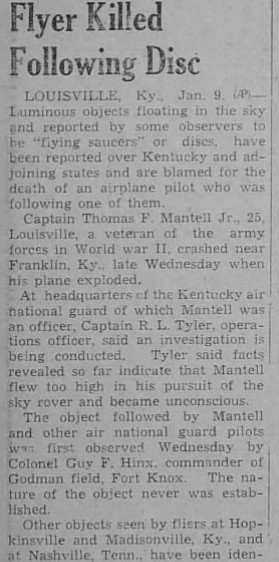
Page 8 Shoshone News-Press Friday Jan. 9th 1948 Newspapers.com
What Happened
Around 1:45 p.m. on a clear winter afternoon, personnel at Godman Army Airfield (part of Fort Knox) began receiving reports of a large, circular object hovering in the sky. Multiple witnesses, including the base commander, Colonel Guy F. Hix, observed the object for nearly an hour. It was described as metallic, huge, and stationary at a high altitude.
Four P-51 Mustang fighters already airborne were diverted to investigate. Captain Thomas Mantell, a 25-year-old experienced pilot with over 2,800 flight hours — including combat missions in World War II — took the lead.
As Mantell climbed, he radioed the tower: “The object is metallic and tremendous in size… It’s above me and I’m still climbing.” He continued his pursuit past 22,000 feet, even though his P-51 was not equipped with oxygen for high-altitude flight. His last transmission reportedly described the object as moving at high speed and appearing to be “a bright metallic object of tremendous size.”
At approximately 3:18 p.m., Mantell’s aircraft entered a steep dive and crashed on a farm near Franklin, Kentucky. He was found dead in the wreckage. The plane had disintegrated during the high-speed descent.
The Official Explanation
The U.S. Air Force initially struggled to explain both the sighting and the crash. After several weeks, investigators concluded that Mantell had most likely been chasing a Skyhook balloon — a large, secret high-altitude research balloon developed by the Navy. These balloons were silvery, could reach extreme altitudes, and often appeared metallic or saucer-shaped when viewed from certain angles.
The crash itself was officially attributed to hypoxia (oxygen deprivation). Without supplemental oxygen, Mantell would have lost consciousness above 20,000 feet, causing his plane to spiral uncontrollably into the ground.
Why the Case Remains Controversial
Despite the official explanation, the Mantell Incident continues to generate debate for several reasons:
- Multiple trained military witnesses described a large, structured object hovering stationary before Mantell gave chase.
- The object was reportedly visible for a long period and appeared much larger than a typical weather or Skyhook balloon.
- The timing — just six months after Kenneth Arnold’s famous sighting and the Roswell incident — fueled public suspicion of a cover-up.
- Some witnesses claimed Mantell described the object as having a “porthole” or structured appearance before contact was lost.
Critics of the Skyhook theory argue that the balloon explanation was a convenient way to close the case quickly during a time of high public interest in UFOs.
Legacy and Historical Significance
The Mantell Incident became one of the first major cases studied by Project Sign, the U.S. Air Force’s initial official UFO investigation program (later renamed Project Grudge and then Project Blue Book). It highlighted the real dangers pilots faced when chasing unidentified objects and raised questions about how seriously the military was taking these reports in the early days of the phenomenon.
For many in the UFO community, the case symbolizes the cost of official secrecy and ridicule. Mantell’s death was a stark reminder that chasing the unknown could have deadly consequences.
Even today, the Mantell Incident remains one of the most discussed “classic cases” because of the combination of credible military witnesses, a pilot fatality, and an official explanation that many still find unsatisfactory.
Further Reading
This page is part of our Classic Cases series, preserving important historical UFO events with context and analysis.