Crop Circles – News and Sightings: Complex Formations That Continue to Intrigue the World
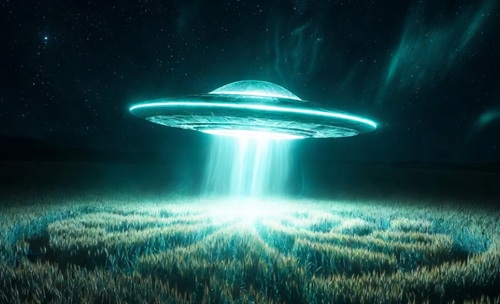
Crop circles have fascinated people for decades. These intricate patterns that appear overnight in fields continue to spark wonder, debate, and scientific curiosity. While the vast majority of modern crop circles are known to be made by humans, a smaller number of formations — especially those from the 1990s and early 2000s — still raise questions due to their size, complexity, precision, and the speed with which they appear.
A Brief History of Crop Circles
Although reports of simple crop circles date back centuries, the modern phenomenon exploded in the late 1970s and reached its peak in the 1990s, primarily in southern England. What began as simple circles evolved into incredibly complex geometric designs, fractals, and even representations of mathematical theorems. Some formations spanned hundreds of feet and contained hundreds of individual elements, all created in a single night.
Notable Recent and Iconic Formations
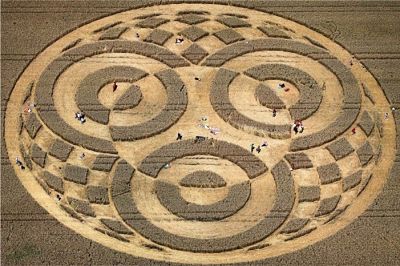
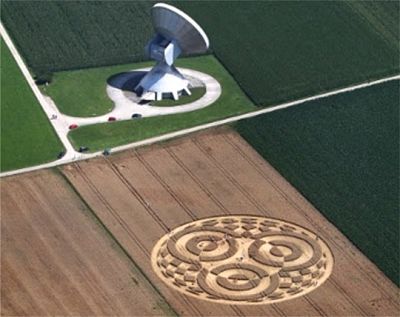
July 28, 2014 – Raisting, Germany
A massive and highly intricate crop circle appeared overnight in a wheat field in Raisting, Bavaria. The formation measured approximately 250 feet in diameter and featured extremely precise geometric patterns and layered elements that impressed researchers and visitors alike.
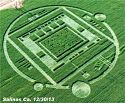
December 30, 2013 – Salinas, California
A striking geometric crop circle was discovered in a field near Salinas, California. The formation displayed remarkable symmetry and mathematical precision when viewed from above, once again highlighting the level of skill involved in these creations.
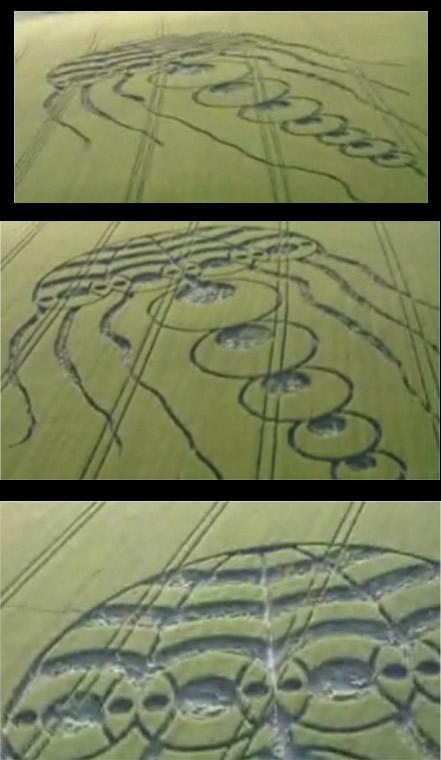
The Famous Jellyfish Crop Circle
One of the largest and most impressive formations ever recorded is the “Jellyfish” crop circle. Measuring nearly 600 feet in length, this intricate design appeared in a single night and featured flowing, organic patterns rarely seen in other formations.
The Hoax Reality and Human Creativity
In recent years there has been a noticeable decline in both the number and complexity of new crop circles. Most researchers and investigators now agree that the vast majority — if not all — of today’s formations are created by human artists, often referred to as “circlemakers.”
Several prominent hoaxers have come forward over the years, demonstrating how quickly large, intricate designs can be made under the cover of darkness using simple tools like planks, ropes, and measuring tapes. Teams have even developed techniques to create bent (but not broken) plant stems that appear anomalous at first glance.
Claims of Anomalous Features
Despite the human origin of most circles, some formations have displayed unusual characteristics, including:
- Blown nodes in the plant stems (as if exploded from inside by intense heat)
- Magnetic anomalies detected in the soil
- Cellular changes in the plants that differ from mechanical flattening
- Extremely precise mathematical and geometric ratios
While some of these features have been replicated by skilled human teams, others remain subjects of ongoing debate among researchers.
Why Crop Circles Still Capture Our Imagination
Even with strong evidence that most crop circles are human-made, they continue to fascinate people worldwide. They represent:
- Human artistic creativity and ingenuity
- Our deep desire for connection with something greater than ourselves
- The possibility of communication from non-human intelligence
- A beautiful and temporary form of land art
The romantic idea that some formations could be messages from extraterrestrial beings or unknown intelligences remains powerful, even if unproven. Crop circles tap into humanity’s ancient fascination with sacred geometry, mystery, and the unknown.
Current Status (2026)
As of 2026, new crop circles still appear every summer, primarily in England, Europe, and occasionally in North America. However, the golden age of mysterious, high-complexity formations appears to have passed. Most new circles are quickly identified as human-made artworks, often announced by the creators themselves on social media.
Nevertheless, the phenomenon continues to draw tourists, researchers, and enthusiasts to the English countryside each summer. Some formations are still studied for their artistic merit and geometric beauty regardless of origin.
Conclusion: Art, Mystery, or Both?
Crop circles occupy a unique place in modern culture. They are simultaneously a form of guerrilla art, a psychological and sociological phenomenon, and — for some — potential evidence of something beyond our current understanding.
Whether created by human hands as elaborate hoaxes and artworks, or by forces we do not yet fully comprehend, crop circles remain one of the most visually stunning and thought-provoking mysteries of our time.
This article is for informational and educational purposes. Most crop circles are created by humans, but the phenomenon continues to inspire wonder and artistic expression worldwide.