Bentwaters Lakenheath UFO Incident: The 1956 Radar-Visual Case
August 13–14, 1956 — The Bentwaters Lakenheath UFO incident stands as one of the strongest and most credible radar-visual UFO cases in history. Occurring over two major U.S. Air Force bases in Suffolk, England, this event involved multiple independent radar systems, visual confirmations by experienced military pilots, and performance characteristics far beyond known aircraft technology of the era.
What Happened During the Bentwaters Lakenheath UFO Incident
The incident began shortly after 9:30 p.m. on August 13 when radar operators at RAF Bentwaters detected an unidentified target approaching from the east at an estimated speed of several thousand miles per hour. The object suddenly stopped and hovered, then accelerated again at high speed. This pattern repeated several times.
Ground radar tracked the object as it merged with other targets before separating again. At one point, a single large return — several times stronger than a B-36 bomber — was observed. RAF Bentwaters immediately alerted nearby RAF Lakenheath, about 40 miles to the northwest.
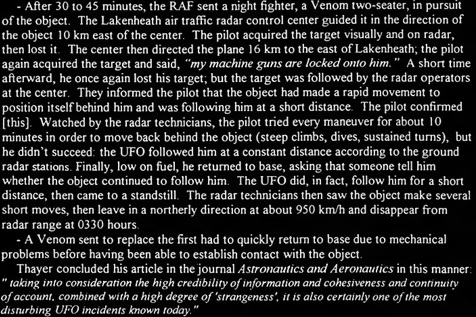
A de Havilland Venom night fighter from RAF Lakenheath was scrambled to intercept. The pilot quickly made visual contact with a bright, circular object. Ground radar confirmed the UFO maneuvering around the jet at extraordinary speeds. In one of the most dramatic moments, the object suddenly positioned itself directly behind the Venom fighter. The pilot radioed in alarm: “He’s on my tail!” before losing contact. Radar showed the object had indeed moved behind the aircraft at high speed.
Why This 1956 UFO Radar Visual Case Is So Credible
The Bentwaters Lakenheath UFO incident is frequently ranked among the best-documented cases because of the quality of evidence:
- Multiple independent radar systems (ground-based at both bases and airborne radar on the interceptor) tracked the same object.
- Visual confirmation by trained military pilots.
- The object demonstrated extreme performance: instant acceleration, hovering, and rapid direction changes that no aircraft of 1956 could match.
- Both U.S. Air Force and Royal Air Force personnel were involved, adding multiple layers of corroboration.
A detailed sighting map showing radar tracks and flight paths further strengthens the documentation of this 1956 UFO radar visual case.
The Official Investigation
The U.S. Air Force investigated the incident through Project Blue Book. Despite the strong radar and visual data, the case was never satisfactorily explained. The final conclusion in Project Blue Book files was simply listed as “Unidentified.”
Declassified documents later revealed that senior military officials took the event seriously. One internal memo noted the object’s ability to outmaneuver the Venom interceptor with ease. The case remains one of the few where the official conclusion acknowledged the high probability of an anomalous object.
Why the Bentwaters Lakenheath UFO Incident Still Matters Today
This 1956 case is particularly significant because it occurred during the height of Cold War tensions and involved active military airbases. It demonstrated that the UFO phenomenon was not limited to civilian witnesses or isolated events. The combination of radar tracking and visual confirmation by pilots made it difficult to dismiss as misidentification or weather phenomena.
The Bentwaters Lakenheath UFO incident is often compared to other strong radar-visual cases and remains a cornerstone example for researchers studying the performance characteristics of UAP. It showed objects capable of speeds and maneuvers that challenged the technological capabilities of both the United States and the Soviet Union at the time.
Even today, the case is studied for what it reveals about how the military handled UFO reports in the early years of the modern UFO era. It highlights the tension between official public statements and internal military concern over these incidents.
Further Reading
- Kenneth Arnold Sighting (1947)
- The Mantell Incident (1948)
- Wikipedia – Lakenheath-Bentwaters Incident
This page is part of our Classic Cases series, preserving important historical UFO events with context and analysis.